KMT Partners

As a small business owner, director, or shareholder, it’s crucial to understand the tax implications of using your company’s money and assets.

This blog post will guide you through the key points to consider when managing your business finances and personal transactions.

Salary, wages, and directors’ fees

If you’re an employee, director, or shareholder of your company, any salary, wages, or directors’ fees you receive must be included in your individual tax return. Your company can generally claim these payments as deductions, provided it complies with Pay As You Go (PAYG) withholding and reporting obligations.

Key responsibilities for your business:

  • Register for PAYG withholding
  • Report payment information using Single Touch Payroll (STP)
  • Pay withheld amounts to the ATO and make compulsory superannuation contributions

Fringe benefits

Fringe Benefits Tax (FBT) applies when your company provides certain benefits to employees, directors, or their associates. This could include payment of private expenses or personal use of company assets.

Important points:

  • Your company may be able to claim deductions for providing fringe benefits
  • An FBT return must be lodged, and any applicable FBT paid
  • Keep detailed records of fringe benefits provided

Dividends and trust distributions

For companies, profits can be distributed as dividends to shareholders. These must be reported in your individual tax return, including any franking credits.

For trusts, the trustee may make beneficiaries entitled to a share of trust income. This should be documented in the trustee resolution and included in the trust tax return.

Lending money or assets

When a private company lends money or assets to shareholders or their associates, it’s essential to be aware of Division 7A rules to avoid deemed dividends.

To avoid Division 7A implications:

  • Repay loans in full or put them on complying terms before the company tax return is due
  • Ensure loan agreements meet specific criteria (e.g., interest rates, maximum terms)
  • Make minimum yearly repayments

For trusts lending money or assets to beneficiaries:

  • Keep accurate records of loans
  • Ensure loans are on commercial terms
  • Be aware of potential integrity rules that may apply

Read more: Navigating shareholder loans

What happens if you don’t report the private use of business assets

Failing to report the private use of business assets can result in several penalties imposed by the Australian Taxation Office (ATO). Here are the key consequences:

  1. Financial penalties:
    The ATO can impose administrative penalties for failing to take reasonable care, making false or misleading statements, or taking a position that is not reasonably arguable. These penalties can range from 25% to 75% of the tax shortfall amount, depending on the severity of the non-compliance.
  2. Interest charges:
    In addition to penalties, the ATO may apply the General Interest Charge (GIC) on any unpaid tax amounts resulting from unreported private use of business assets. This interest accrues daily and compounds.
  3. Audit and increased scrutiny:
    Failure to report private use of business assets can trigger an ATO audit. This often leads to increased scrutiny of your business affairs, potentially extending beyond the initial issue.
  4. Amended assessments:
    The ATO can issue amended tax assessments for previous years if they discover unreported private use of business assets. This can result in additional tax liabilities, penalties, and interest charges for multiple years.
  5. Division 7A consequences:
    For companies, unreported private use of business assets by shareholders or their associates may be treated as deemed dividends under Division 7A. These dividends are generally unfranked, meaning the full amount is taxable without the benefit of franking credits.
  6. Fringe benefits tax (FBT) liability:
    If the private use relates to employees or directors, the business may face FBT liabilities, including penalties for non-lodgment or under-reporting of FBT returns.
  7. Loss of deductions:
    The ATO may disallow claimed deductions related to the assets used privately, potentially increasing taxable income and tax payable.
  8. Prosecution for serious cases:
    In extreme cases of deliberate non-compliance or fraud, the ATO can pursue criminal prosecution, which may result in fines or imprisonment.

Best practices

To maintain transparency and avoid unintended tax consequences:

  • Set up separate bank accounts for business and personal expenses
  • Keep detailed records of all transactions
  • Ensure company loans comply with Division 7A
  • Report all transactions correctly for tax purposes

Remember, if you make an honest mistake, it’s best to inform the ATO or your registered tax agent as soon as possible.

Reference: ATO

By understanding these tax implications and following best practices, you can effectively manage your business finances while staying compliant with tax regulations.

Always consult with our KMT registered tax professional for personalised advice tailored to your specific situation. Contact KMT advisers now!

About our advisers: 

Chrisanthe Lekatis is renowned for her expertise in management accounting, virtual CFO services, and top-tier business advice. She empowers management with tailored strategies for success, streamlining processes to achieve efficient and cost-effective outcomes. Her commitment to building trust and lasting relationships goes beyond professional excellence; it’s a personal ethos. By actively listening and understanding her clients’ businesses and goals, Chrisanthe thrives on collaborative efforts to navigate challenges and collectively achieve their aspirations. Please do not hesitate to reach out if you need assistance.

Michael Fox has been dedicated to the success of his clients, devising comprehensive wealth strategies for both personal and business growth for over 4 decades. With extensive expertise in business governance and family business succession, Michael specialises in empowering emerging businesses and family enterprises by fostering renewal, enhancing value and smooth transitions to the next generation. Please do not hesitate to reach out if you need assistance.

This is general advice only and does not take into account your financial circumstances, needs and objectives. Before making any decision based on this document, you should assess your own circumstances or seek tax advice from a qualified accountant at KMT Partners. Information is current at the date of issue and may change.
KMT Partners

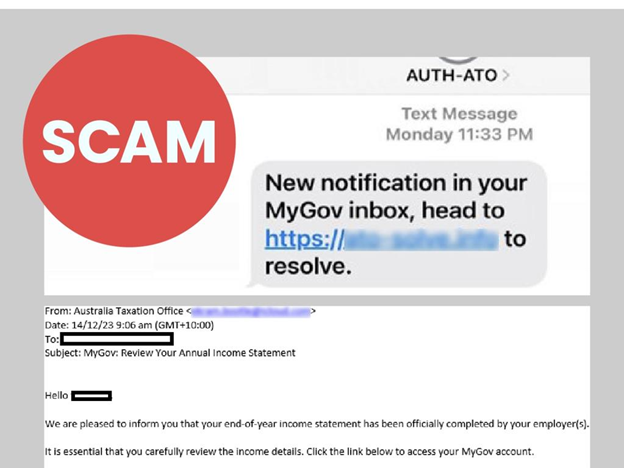
There has been a surge in ATO tax scams in recent years. These fraudulent schemes target unsuspecting individuals through various channels, including emails, phone calls, and text messages.

Let’s explore some common scams and learn how to protect yourself.

Tax Scam 1: Refund hoax

Scammers often send ATO-branded emails prompting recipients to click on links for supposed tax refunds. One prevalent example uses the phrase “You are due to receive an ATO Direct refund”.

The ATO will never send SMS or emails with links to access online services. Always access ATO services directly through ato.gov.au.

Tax Scam 2: Fake myGov emails

A heartless scam targeting myGov users has been doing the rounds, prompting a warning from the ATO and Services Australia for the public to be aware of scammers impersonating government agencies.

Scammers sent ATO-branded emails to users telling them: “You have a new message in your myGov inbox – click here to view”.

Tax Scam 3: Multi factor authentication email scams

The ATO has also reported an increase in reports of scammers impersonating the ATO and emailing the public to falsely advise them of security updates that require an update to the multifactor authentication on a person’s ATO account.

The scam email includes a QR code which takes the user to a fake myGov sign in page, designed to steal their myGov sign in details.

The ATO would never send an email with a QR code or a link to log in to online services.

Tax Scam 4: Tax time SMS and email scams

The ATO has previously warned to tax time ATO SMS and email scams. Scammers use different phrases to try and trick recipients into opening the dodgy links, such as:

“You are due to receive an ATO Direct refund”

“You have an ATO notification”

“You need to update your details to allow your Tax return to be processed”

“We need to verify your incoming tax deposit”

“ATO Refund failed due to incorrect BSB/Account number”

“Due to receive a refund, click here to receive a rebate”

Tax Scam 5: Social media account scams

Scammers have also created fake social media accounts impersonating the ATO across Facebook, Twitter, TikTok, Instagram and other platforms.

These fake accounts ask users to send them a direct message so they can help with their ATO query in a bid to steal personal details including phone numbers, email addresses and bank account information.

The ATO’s only official accounts are on Facebook, X and LinkedIn. They urged the public to only follow their verified accounts and to make sure any email addresses provided end with ‘.gov.au’.

Protecting yourself from tax scams

Always be cautious about sharing personal information. Scammers can use this data to access bank accounts and commit fraud in your name. Never share sensitive details like myGov login credentials, Tax File Numbers, or bank account information.

What should you do if you get scammed?

If you suspect your personal information has been compromised, call the ATO immediately on 1800 467 033. They’ll investigate and place additional protection on your ATO account.

For privacy reasons, the ATO may not leave a message unless your voicemail clearly identifies who you are.

How does the ATO contact you?

It’s crucial to remember that the ATO will never:

  • Send texts or emails with links to services
  • Ask for your tax file number or bank details via email, SMS, or social media

Stay informed and seek help!

By staying aware of these scams and knowing how the ATO operates, you can better protect yourself from falling victim to these fraudulent schemes. If you’re ever unsure about a communication claiming to be from the ATO, it’s always best to contact them directly through official channels.

Please feel free to contact us if you need tax assistance. Our expert accounting team is here to help you!

About our advisers: 

Michael Fox has been dedicated to his clients’ success, devising comprehensive wealth strategies for personal and business growth for over four decades. With extensive expertise in business governance and family business succession, Michael specialises in empowering emerging businesses and family enterprises by fostering renewal, enhancing value, and smoothing transitions to the next generation. Please do not hesitate to reach out if you need assistance.

Chrisanthe Lekatis is renowned for her expertise in management accounting, virtual CFO services, and top-tier business advice. She empowers management with tailored strategies for success, streamlining processes to achieve efficient and cost-effective outcomes. Her commitment to building trust and lasting relationships goes beyond professional excellence; it’s a personal ethos. By actively listening and understanding her clients’ businesses and goals, Chrisanthe thrives on collaborative efforts to navigate challenges and collectively achieve their aspirations. Please do not hesitate to reach out if you need assistance.

This is general advice only and does not take into account your financial circumstances, needs and objectives. Before making any decision based on this document, you should assess your own circumstances or seek tax advice from a qualified accountant at KMT Partners. Information is current at the date of issue and may change.

KMT Partners

Recently the Federal Court considered the tax implications of the restructure of a group that occurred in late 2016. The ATO raised amended assessments of over $100 million even though there was no real profit or gain for the group when undertaking the restructure.

How could this happen?

The restructure had the prime purpose of ridding the group of Division 7A loans. These loans had been put on complying Division 7A loan agreements. These agreements required that minimum yearly repayments be made to various companies. The business had declining profits and it became impossible to fund the yearly repayments required by Division 7A.

A restructure was proposed by the taxpayer’s accountants to solve the problem. Using a capital gains tax rollover relief provision, the taxpayers effectively extracted value from their operating business by engaging in a selective share buy-back. The taxpayers used what was owed to them from the share buy-back to pay off the amounts (Division 7A loans) they had borrowed from various companies in the group.

Despite there being no profit made, the ATO said that the group restructure was undertaken in substitution for paying dividends. If dividends had been paid, so the ATO argued, they would have become assessable income to the shareholders and significant tax would have been paid instead of none.

The Federal Court said that the arguments of the ATO were wrong. The Court looked to the past history of the group and concluded that dividends had never been paid in the way the ATO was suggesting. Further, there was no profit made, so there was nothing to tax. The taxpayers won the case.

This case points out the fact that the ATO can still try to find something to tax even when there was no real gain. The reason for this is that the Australian taxation law does not (always) purport to tax real gains. Sometimes it can tax fictitious gains that have only been created because of the way the tax law is worded.

Also, it shows that the ATO sometimes gets things wrong. Sometimes business owners can be frightened or overawed by the ATO when it comes knocking. Don’t be. Take a deep breath and get good advice.

Contact our KMT advisers for assistance with business structure.

About our advisers: 

Michael Fox has been dedicated to his clients’ success, devising comprehensive wealth strategies for personal and business growth for over four decades. With extensive expertise in business governance and family business succession, Michael specialises in empowering emerging businesses and family enterprises by fostering renewal, enhancing value, and smoothing transitions to the next generation. Please do not hesitate to reach out if you need assistance.

Chrisanthe Lekatis is renowned for her expertise in management accounting, virtual CFO services, and top-tier business advice. She empowers management with tailored strategies for success, streamlining processes to achieve efficient and cost-effective outcomes. Her commitment to building trust and lasting relationships goes beyond professional excellence; it’s a personal ethos. By actively listening and understanding her clients’ businesses and goals, Chrisanthe thrives on collaborative efforts to navigate challenges and collectively achieve their aspirations. Please do not hesitate to reach out if you need assistance.

This is general advice only and does not take into account your financial circumstances, needs and objectives. Before making any decision based on this document, you should assess your own circumstances or seek tax advice from a qualified accountant at KMT Partners. Information is current at the date of issue and may change.

KMT Partners

Individual income tax thresholds effective from 1 July 2024

The Stage 3 individual income tax thresholds will start to apply from 1 July 2024. These should result in lower tax paid by everyone. If your business has employees, you will need to ensure that your payroll system takes into account these tax threshold changes for any salary packaging arrangements with employees.

The new tax brackets following the implementation of the stage three tax cuts will be:

Taxable income

$0–$18,200

$18,200–$45,000

$45,000–$135,000

$135,000-$190,000

$190,000 and over

Tax rate

Nil

16%

30%

37%

45%

Superannuation guarantee increases to 11.5%

This is the biggest change that will affect you this year.

From 1 July 2024, the Superannuation Guarantee rate will increase from 11% to 11.5%. It is planned to increase by 0.5% each year until it reaches 12% on 1 July 2025.

If any employees are paid on a “total remuneration” basis (a package inclusive of superannuation), this will mean that their take home pay will reduce by 0.5% unless the employer decides to increase their total remuneration by 0.5%.

For employees who are paid wages or salary plus superannuation, then their take home pay will remain the same and the 0.5% increase will be added to their superannuation payments.

All employers will need to give immediate action to managing this increase, and they will need to factor in this increase to their cash flow planning for 2024/2025.

Cryptocurrency

The Australian Taxation Office (ATO) is concerned that many taxpayers believe their cryptocurrency gains are tax free or only taxable when the holdings are cashed back into Australian dollars.

Gains from cryptocurrency are similar to gains from other investments, such as shares. Generally, as an investor, if you buy, sell, swap for dollar currency, or exchange one cryptocurrency for another, it will be subject to capital gains tax (CGT) and must be reported. CGT also applies to the disposal of non-fungible tokens (NFTs).

It is vital that you keep good records of your cryptocurrency exchanges. The ATO has access to the data from crypto platforms and banks and is running data matching to ensure tax is paid on all crypto gains.

The tax laws are complex on this area – so please contact our KMT advisers to ensure you receive the right advice.

Temporary full expensing replaced with $20,000 instant asset write-off

The unlimited tax deduction for purchases of business assets known as Temporary Full expensing finished on 30 June 2024.

From 1 July 2023, assets costing less than $20,000 can be instantly written off. Assets costing more than $20,000 will need to be depreciated. Please note that this $20,000 limit is subject to legislation being approved by Federal Parliament.

Important: If you have claimed the full cost of an asset – for example a motor vehicle – in a prior year using temporary full expensing, when you sell it in the future you will have the full value of its sale price included in your taxable income for the year!

Single touch payroll

If you are reporting payments to employees to the ATO using Single Touch Payroll (STP), most businesses will need to lodge a STP Finalisation Declaration with the ATO by 14 July 2024.

Employees will be able to access their Income Statement through their MyGov account.

Reportable fringe benefits

Where you have provided fringe benefits to your employees more than $2,000, you need to report the FBT grossed-up amount.  This is referred to as a `Reportable Fringe Benefit Amount’ (RFBA) amount, and it needs to be updated for each employee as part of your Single Touch Payroll finalisation procedure for 2024.

Stocktake

Businesses that buy and sell stock generally need to do a stocktake at the end of each financial year as the increase or decrease in the value of stock is included when calculating the taxable income of your business.

If your business has an aggregated turnover below $10 million, you can use the simplified trading stock rules. Under these rules, you can choose not to conduct a stocktake for tax purposes if the difference in value between the opening value of your trading stock and a reasonable estimate of the closing value of trading stock at the end of the income year is less than $5,000.  You will need to record how you calculated the value of trading stock on hand.

If you do need to complete a stocktake, you can choose one of three methods to value trading stock:

  • Cost price – all costs connected with the stock including freight, customs duty, and if manufacturing, labour and materials, plus a portion of fixed and variable factory overheads.
  • Market selling value – the current value of the stock you sell in the normal course of business (but not at a reduced value when you are forced to sell it).
  • Replacement value – the price of a substantially similar replacement item in a normal market on the last day of the income year.

A different basis can be chosen for each class of stock or for individual items within a particular class of stock. This provides an opportunity to minimise the trading stock adjustment at year-end. There is no need to use the same method every year; you can choose the most tax effective option each year. The most obvious example is where the stock can be valued below its purchase price because of market conditions or damage that has occurred to the stock. This should give rise to a deduction even though the loss has not yet been incurred.

Reporting payments to contractors

A “Taxable Payments Annual Report” (TPAR) is due for lodgement with the ATO by 28 August 2024 for the following industries:

  • Building and construction services
  • Cleaning services
  • Courier services
  • Road freight services
  • Information technology (IT) services – including software development
  • Security, investigation or surveillance services
  • Mixed services (providing one or more of the services listed above)

This report includes a listing and total of all payments and non-cash benefits made to contractors during the year.

Payroll tax

Payroll tax applies to all entities that have an Australian payroll that exceeds state-based limits.

You should note that in addition to normal salaries and wages, the following items are generally also included in payroll expenses if payroll tax applies:

  • Fringe benefits based on the grossed-up taxable value of fringe benefits;
  • All employer contributions to superannuation on behalf of employees; and
  • Some contractor or sub-contractor fees.

For more detailed information about whether payroll tax applies to your business, please contact our office.

The Annual Return/Reconciliation for payroll tax must be lodged by 21 July 2024 (Queensland, Victoria, Northern Territory, Tasmania and WA) or by 28 July 2024 (NSW and South Australia) with your State Revenue Office.

Workcover/ Worksafe

Your WorkCover/WorkSafe insurer sends an annual reconciliation to all registered employers at the end of the financial year.

In completing your annual reconciliation, you will need to include the following items in addition to normal salaries and wages:

  • Fringe benefits based on the taxable value of fringe benefits (do not gross-up);
  • All employer contributions to superannuation on behalf of employees; and
  • Some contractor or sub-contractor fees.

For more detailed information about what items to include in the reconciliation statement, please contact our office.

Once the reconciliation is received and processed by your WorkCover/WorkSafe insurer, you will be issued with a final assessment or a refund depending on the instalments you have paid during the year.

Complete and lodge the Annual Reconciliation with your WorkCover/WorkSafe insurer by the due date.

ATO audit activity

Please note that the ATO and State Revenue Office are constantly increasing their audit activities. There has been an increase in audit activity for PAYG Withholding, Payroll Tax, WorkCover, GST, Division 7A loan accounts from companies, and Trust distributions from Discretionary Trusts.

We can offer a review of your records and record-keeping procedures if you are concerned about your ability to satisfy an audit.

Please contact our KMT office if you would like to request this service.

About our advisers: 

Michael Fox has been dedicated to his clients’ success, devising comprehensive wealth strategies for personal and business growth for over four decades. With extensive expertise in business governance and family business succession, Michael specialises in empowering emerging businesses and family enterprises by fostering renewal, enhancing value, and smoothing transitions to the next generation. Please do not hesitate to reach out if you need assistance.

Chrisanthe Lekatis is renowned for her expertise in management accounting, virtual CFO services, and top-tier business advice. She empowers management with tailored strategies for success, streamlining processes to achieve efficient and cost-effective outcomes. Her commitment to building trust and lasting relationships goes beyond professional excellence; it’s a personal ethos. By actively listening and understanding her clients’ businesses and goals, Chrisanthe thrives on collaborative efforts to navigate challenges and collectively achieve their aspirations. Please do not hesitate to reach out if you need assistance.

This is general advice only and does not take into account your financial circumstances, needs and objectives. Before making any decision based on this document, you should assess your own circumstances or seek tax advice from a qualified accountant at KMT Partners. Information is current at the date of issue and may change.

KMT Partners

Effective governance is the cornerstone of business success and longevity.

Good governance is about structuring, operating, and controlling a company with a view to achieving long-term strategic goals for shareholders, creditors, employees, customers, and suppliers.

The effect of good governance is the realisation of the company’s desired vision and purpose due to achieving the required results and outcomes operationally in the business.

Why is good governance so important?

At a base level, good governance allows a business to keep operating:

1.  Shareholders continue to invest money and time.
2.  Funders continue to fund the business.
3.  Suppliers continue to supply and allow credit because they sense a stable business environment.
4.  Regulators (if any) allow the company to continue, as compliance matters are being met.
5.  Customers continue to support the business by buying from it.
6.  Employees continue to have faith in the business and continue providing their services.

How big does a company need to be to benefit from a governance process?

We would argue that the majority of companies, even smaller ones, would benefit from more effective governance.  After all, “A big business starts small” 

– Richard Branson

When a business is small, governance tends towards ad-hoc and laid back.  On the other hand, when a business is large, governance can tend towards overly bureaucratic and arrogant.

The best governance, for all sizes of business, involves:

  • Everything that’s needed; nothing that’s not
  • Intense professional will, with deep personal humility
  • Consensus without ‘groupthink’

Governing versus managing a business

GOVERNANCE

MANAGEMENT

Job Overview

Strategic

Operational, tactical

The Job

Given the purpose, what is our vision, and what strategies will the company use to get there?

Given the strategy, what does the team have to do to implement the plan?

Accountable to

Shareholders and the company

The directors

Monitoring

  1. Where are we and how did we get here?
  2. Where are we heading, and do we want to go there?
  3. What do we have to do to get this right?

Are we on track with our goals, team, and performance?

Governance planning

Good governance isn’t so much about learning a set of rules and procedures; it’s about having a mindset that desires to have a well-governed business.  And you need some practices and coaching to get you there.

Contact our trusted KMT advisers to develop your Governance Plan and implement best practices.

About our adviser: Michael Fox has been dedicated to the success of his clients, devising comprehensive wealth strategies for both personal and business growth for over four decades. With extensive expertise in business governance and family business succession, Michael specialises in empowering emerging businesses and family enterprises by fostering renewal, enhancing value and smooth transitions to the next generation. Please do not hesitate to reach out if you need assistance with governance planning.

This is general advice only and does not take into account your financial circumstances, needs and objectives. Before making any decision based on this document, you should assess your own circumstances or professional advice from your accountants at KMT Partners.

KMT Partners

Hutt St Centre’s Walk a Mile in My Boots allows South Australians to step out and support people experiencing homelessness.

Hutt St Centre has been supporting people experiencing homelessness for over 68 years by providing a safe and welcoming space so they can rebuild their lives.

This August, our team at KMT Partners will take part in the Walk a Mile in My Boots challenge.

We are doing it to raise vital funds for Hutt St Centre because every dollar goes to help people in our community who are facing challenges. 

Your donation (which is fully tax-deductible!) will give people access to healthy meals, hot showers, laundry facilities, and life-changing medical care… 

With a focus on the future, our fundraising efforts also help connect people with housing, education, and employment opportunities so they can build the skills and confidence to change their circumstances for good.

Donations help to give someone in need a safe and welcoming place to go at Hutt St Centre, where they’ll get a nutritious breakfast and lunch. We would greatly appreciate your support!

KMT Partners

Shareholder loans pose a significant challenge within Australian tax law, particularly for businesses structured as private companies.

If you operate a business through a private company (identifiable by ‘Pty Ltd’ in the name) or have one in your business structure, it’s crucial to understand the tax issue of loans to shareholders or their associates. This article explores the potential tax consequences and how to avoid them.

For over seven decades, Australian tax policy has aimed to prevent private companies from distributing profits in disguised ways. One such method is when a company lends money to its shareholders or their associates. The term ‘associate’ is broadly defined, typically including most family members and related entities.

The tax implications

When a company makes such a loan, the tax law may deem it an unfranked dividend in the year the loan is made. This can lead to significant tax liabilities for the recipient.

Here is an example.

The Light Family Consider Bob and Betty Light, who operate their business through Light Up Pty Ltd. During the financial year ending June 30, 2024, they borrowed $90,000 from the company without a formal agreement, interest, or repayment plan.

If nothing is done, Bob and Betty Betty (who are the shareholders of the company) will be deemed to have received an unfranked dividend of $90,000 as of at30 June 2024. On the assumption that they each borrowed 50% of the $90,000, Bob and Betty will need to include in their tax return assessable income an amount of $45,000 each. This will be assessed at their marginal tax rates. There will be no franking credit refund as the law deems the dividends to be unfranked. The reason for the loans is irrelevant.

How to avoid a deemed dividend

There are two ways in which Bob and Betty can avoid the deemed dividend outcome.

The first is for the $90,000 to be repaid to the company, in full, by the tax return lodgement date of the company. This is likely to be 15 May 2025. No interest on the loan need be paid.

However, often in family business situations, money borrowed from a company cannot be easily repaid. This is because the money has been spent on acquiring assets, going for holidays, funding education costs and so forth. Funds cannot be found to repay the loan to the company.

So, the second method of avoiding a deemed unfranked dividend is for the loan to be put under the terms of a ‘complying Division 7A loan agreement’. This must be done before the tax return lodgement date of Light Up Pty Ltd for the year ended 30 June 2024 (as above, 15 May 2025).

Complying Division 7A loan agreements require interest and principal to be paid each year. These payments are called ‘minimum yearly repayments’. The interest rate charged changes each year. For the year ended 30 June 2024, the interest rate was 8.27%.

The term of the loan must be no more than 7 years. However, if the loan is secured by mortgage over real property, the term can be a maximum of 25 years. Further, if the loan is secured over real property, the value of the property (less the amounts of any other liabilities secured over that property in priority to the loan) must be at least 110% of the amount of the loan.

Once the complying Division 7A loan agreement has been entered into, minimum yearly repayments must be made on or before each subsequent 30 June during the term of the loan or a deemed dividend will arise. It is important that cash flow planning is undertaken to ensure that the loan repayment funds are available each year.

Trusts distributing to companies

Deemed dividends can also arise when a trust distributes income to a private company and does not pay the amount to the company. This is known as an ‘unpaid present entitlement’. It is the current view of the Australian Taxation Office (‘ATO’) that such amounts are loans from the private company to the trust and could create a deemed unfranked dividend if not fully repaid or put on the terms of a complying Division 7A loan agreement, as referred to above.

However, the ATO view is being challenged in the Full Federal Court. This challenge will be heard by the Court in late August 2024 and a decision is not expected until the first half of calendar year 2025.

The issue of deemed unfranked dividends arising from loans to shareholders of private companies is the ‘problem child’ of the Australian tax law for small business owners and investors. The loans are often referred to as ‘Division 7A’ loans. Division 7A is a very complex piece of legislation and if it applies to you, you must obtain expert guidance on its operation.

Proper financial planning and understanding of these rules can help you avoid unexpected tax liabilities and ensure your business structure remains compliant.

Contact KMT advisers now for your tax planning assistance!

About our advisers: 

Michael Fox has been dedicated to the success of his clients, devising comprehensive wealth strategies for both personal and business growth for over 4 decades. With extensive expertise in business governance and family business succession, Michael specialises in empowering emerging businesses and family enterprises by fostering renewal, enhancing value and smooth transitions to the next generation. Please do not hesitate to reach out if you need assistance.

Chrisanthe Lekatis is renowned for her expertise in management accounting, virtual CFO services, and top-tier business advice. She empowers management with tailored strategies for success, streamlining processes to achieve efficient and cost-effective outcomes. Her commitment to building trust and lasting relationships goes beyond professional excellence; it’s a personal ethos. By actively listening and understanding her clients’ businesses and goals, Chrisanthe thrives on collaborative efforts to navigate challenges and collectively achieve their aspirations. Please do not hesitate to reach out if you need assistance.

This is general advice only and does not take into account your financial circumstances, needs and objectives. Before making any decision based on this document, you should assess your own circumstances or seek tax advice from a qualified accountant at KMT Partners. Information is current at the date of issue and may change.

KMT Partners

A new financial year means a reset financial calendar.


To maintain ATO compliance for your business, it is crucial to stay mindful of the essential tax dates associated with mandatory lodgements. To assist you with this, we have prepared an accounting calendar that outlines all the important dates to note and remember. By keeping track of these dates, you will not only stay updated on tax deadlines but also effectively plan for financial reporting. This calendar will ensure you have the necessary information ready for your accountants or KMT tax agent, enabling timely and smooth processing.

Save this calendar, take notes, and stay organised to ensure your business operates smoothly and remains compliant with ATO regulations.

This calendar provides a summary of upcoming important dates for this financial year. Download the iCalendar files below to save in your work calendar by simply clicking the attached links to the dates below:

The KMT office will be closed over the Christmas/New Year holiday from 20 December 2024 to 5 January 2025.

Download your PDF calendar here

Contact KMT accountants now for tax advice or if you need assistance with your business tax!

KMT Partners

Small business owners will be pleased to know that at the ‘last minute’ the instant asset write-off level for the year ended 30 June 2024 was confirmed at $20,000.

This means, for eligible assets, a 100% tax deduction can be claimed for an asset purchased during that year. The asset must have been installed and ready for use by midnight on 30 June 2024.

There was confusion over whether the write-off level would be $30,000, $20,000 or $1,000. This was because the Senate in Canberra had sent the House of Representatives a message that it would only agree to a level of $30,000. The House of Representatives sent a message back to the Senate that it still wanted the $20,000 level that had been proposed and had been passed by the House of Representatives.

In the last sitting week for the Senate for the 2024 financial year, the Senate agreed not to push for the $30,000 level and passed the legislation that contained the $20,000 level. That was great news for small businesses because if the legislation had not been passed, the level would have reverted to $1,000 under existing law.

Year ending 30 June 2025

While on this topic, the Federal Government has introduced a Bill into Parliament that will (again) extend the instant asset write-off level to $20,000 for the year ending 30 June 2025. This, of course, must also be passed by the Senate and it will be interesting to see whether the Senate adopts the same position that the write-off level should be $30,000. We will have to wait and see.

Why does this keep happening?

You may righly ask why there needs to be legislation each year that extends the instant asset write-off? Why doesn’t the Government simply change the law to a particular level (say $20,000) and leave it there?

Technically, the instant asset write-off level is fixed at $1,000. This is the default level embedded in the legislation. However, for some years now successive Governments have introduced ‘transitional’ legislation that temporarily raises the level for one year (or a particular set periof). Once the transitional legislation expires, the level reverts back to $1,000.

If you were cynical, you might think that successive Governments are doing this because it enables them, each year, to make an announcement of the benefits thay providing to the small business community. But we wouldn’t want to be cynical, would we?

Contact KMT accountants now for your tax planning advice!

About our advisers: 

Chrisanthe Lekatis is renowned for her expertise in management accounting, virtual CFO services, and top-tier business advice. She empowers management with tailored strategies for success, streamlining processes to achieve efficient and cost-effective outcomes. Her commitment to building trust and lasting relationships goes beyond professional excellence; it’s a personal ethos. By actively listening and understanding her clients’ businesses and goals, Chrisanthe thrives on collaborative efforts to navigate challenges and collectively achieve their aspirations. Please do not hesitate to reach out if you need assistance.

Michael Fox has been dedicated to the success of his clients, devising comprehensive wealth strategies for both personal and business growth for over 4 decades. With extensive expertise in business governance and family business succession, Michael specialises in empowering emerging businesses and family enterprises by fostering renewal, enhancing value and smooth transitions to the next generation. Please do not hesitate to reach out if you need assistance.

This is general advice only and does not take into account your financial circumstances, needs and objectives. Before making any decision based on this document, you should assess your own circumstances or seek tax advice from a qualified accountant at KMT Partners. Information is current at the date of issue and may change.

KMT Partners

In the fast-paced world of small business ownership, time is undeniably one of the most precious commodities. Each moment presents an opportunity for growth, innovation, and profitability.

However, in the hustle and bustle of daily operations, many small business owners find themselves overwhelmed with tasks, often falling victim to procrastination and inefficiency. This is where Brian Tracy’s timeless classic, “Eat That Frog!” comes into play, offering invaluable insights and strategies to help small business owners conquer procrastination and skyrocket productivity.

What is “eat that frog” methodology?

“Eat the frog” is a saying that motivational speaker Brian Tracy coined for a time management strategy that can be highly effective for business owners and professionals.

Mark Twain once said that if the first thing you do each morning is to eat a live frog, you can go through the day with the satisfaction of knowing that it is probably the worst thing that is going to happen to you all day long.

Now that is one interesting inspirational quote.

But don’t worry, you don’t really have to eat a real frog to be successful!

In reality, your “frog” is your biggest, most important task. It is the one you are most likely to procrastinate on if you don’t do something about it.

At the heart of Tracy’s methodology lies the powerful metaphor of “eating the frog” – tackling the most challenging and important tasks first thing in the morning. Just as the idea of eating a live frog is daunting, so too are the tasks that we tend to put off. By confronting these tasks head-on and completing them without delay, small business owners can eliminate procrastination and set the tone for a highly productive day.

The Pareto Principle

One of the key principles emphasised in “Eat That Frog!” is the 80/20 rule, also known as the Pareto Principle. This principle suggests that 80% of results come from 20% of efforts. Applied to time management, it means identifying the critical tasks that contribute the most to business success and prioritising them above all else. For small business owners, this might involve focusing on revenue- generating activities, nurturing key client relationships, or implementing strategic initiatives that drive growth.

the ABCDE method of prioritisation

Another valuable concept introduced by Tracy is the ABCDE method of prioritisation. This involves categorising tasks based on their importance and urgency, allowing small business owners to allocate their time and energy more effectively. “A” tasks are the most important and should be tackled immediately, while “B” tasks are important but not as urgent, and “C” tasks are nice to do but not essential. By focusing on “A” tasks and delegating or eliminating lower-priority tasks, small business owners can make significant strides towards their goals.

Effective time management

Furthermore, Tracy emphasizes the necessity of clarity and purpose in time management. Setting clear goals and breaking them down into actionable steps empowers entrepreneurs to stay focused and motivated. Visualizing desired outcomes serves as a compass, guiding small business owners towards success.

Time management is not just about doing more tasks; it’s about doing the right tasks efficiently. In “Eat That Frog!”, Tracy introduces the concept of time blocking, which involves scheduling specific blocks of time for focused work on high-priority tasks. By minimising distractions and dedicating uninterrupted time to important activities, small business owners can maximise productivity and achieve better results in less time.

Moreover, Tracy emphasises the importance of self-discipline and personal responsibility in effective time management. Small business owners must take ownership of their time and commit to making the necessary changes to improve their productivity habits. This might involve setting boundaries, saying no to distractions, and developing routines that optimise performance.

The benefits

The benefits of applying the “Eat That Frog” principle in business include:

  • Increased productivity by ensuring the most important work gets done each day
  • Avoiding procrastination on critical tasks
  • Building momentum and a sense of accomplishment early in the day
  • Freeing up time and energy later in the day for other priorities

Overall, the “Eat That Frog” method is a simple yet powerful time management technique that can help business owners and professionals make steady progress on their most important goals

About our adviser: Michael Fox is our Managing Director at KMT Partners. He has been dedicated to the success of his clients, devising comprehensive wealth strategies for both personal and business growth for over 4 decades. With extensive expertise in business governance and family business succession, Michael specialises in empowering emerging businesses and family enterprises by fostering renewal, enhancing value and smooth transitions to the next generation. Please do not hesitate to reach out if you need assistance.

Chrisanthe Lekatis is renowned for her expertise in management accounting, virtual CFO services, and top-tier business advice. She empowers management with tailored strategies for success, streamlining processes to achieve efficient and cost-effective outcomes. Her commitment to building trust and lasting relationships goes beyond professional excellence; it’s a personal ethos. By actively listening and understanding her clients’ businesses and goals, Chrisanthe thrives on collaborative efforts to navigate challenges and collectively achieve their aspirations. Please do not hesitate to reach out if you need assistance.

This is general advice only and does not take into account your financial circumstances, needs and objectives. The article should not be relied upon as specific information or advice without obtaining appropriate professional advice after a detailed examination of your particular situation from a qualified KMT adviser.